Reduce your irrigation costs. Increase your yields. Manage your irrigation cycles with precision.

Akuasense designs the next generation of connected soil moisture probes for farmers.

Enter the era of data-driven farming.

Satisfaction
guarantee

3-year
warranty

Installation
< 10 min

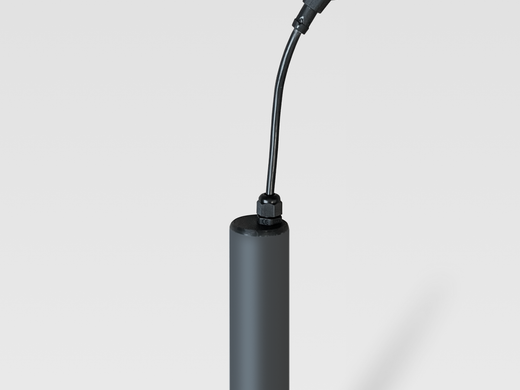
AKS probe installed in the field

500+
probes sold

  • Made in France
  • 100% autonomous
  • 4G included, no plan needed
  • GPS included
  • Installation < 10 min
  • 3-year warranty

What soil moisture probes bring to your farm.

Immediate results for your yield and costs.

  • Up to 30% water savings

    Irrigate only when your plants really need it.

    • Waste reduction Irrigate only when necessary — no wasted energy or water.
    • Lower energy costs Less water pumped = less energy consumed = lower costs.
  • Up to 15% more yield

    • Eliminate water stress And promote optimal nutrient uptake.
    • Improved quality Better-irrigated plants produce more uniform, better-sized vegetables and develop fewer water-related diseases.
  • Fewer fertilizer losses from leaching

    • Better fertilizer use Irrigate optimally to maximise nutrient efficiency in the soil.
    • Better treatment efficacy Thanks to optimal moisture conditions at application time.

Data-driven farming is becoming the norm in 2026.

Weather and experience help you decide. Data lets you optimise.

Without real measurements in the root zone, every irrigation cycle is a guess. The result:

  • avoidable losses every cycle
  • yields still underperforming

+12.3% annual growth in the precision irrigation market. The market will have doubled by 2030. Evidence of growing adoption of precision irrigation technologies.

Up and running in under 10 minutes.

From drilling to receiving your first moisture data.

To know where to position your probes in your plots, refer to this practical guide.

Where should I position my probes?

Your data arrives automatically

Every hour, the probe transmits moisture and temperature at each depth via the 4G network. SIM card and data plan included in the subscription. Data appears automatically on Akua Hub — on your phone, tablet or computer.

Decide at a glance

The platform interprets the data and tells you in real time the moisture status of each plot: irrigate now, wait, or you've already over-irrigated. No raw numbers to interpret — immediate visual indicators.

A complete solution: autonomous 4G gateway, multi-depth soil moisture probe and Akua Hub platform.

Akuasense soil moisture probes showroom

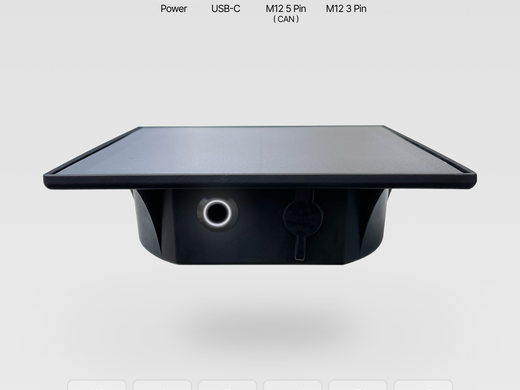
A smart 4G gateway, 100% energy-autonomous

Solar charging
4G LTE
GPS
Akuasense 4G gateway, front view
  • Integrated solar panel, no recharging needed
  • 4G transmission
  • Transmission frequency: every hour
  • Up to 3 probes on 1 single 4G gateway
  • Compatible with Watermark 200SS probe
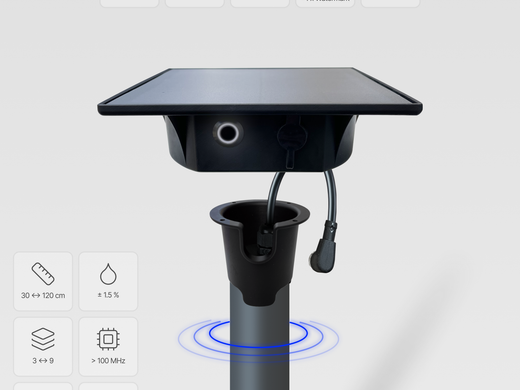
  • Directly clipped onto the probe or remote-mounted on a mast
  • Operating range −30°C to +70°C
  • GPS position for plot location

Precise multi-depth capacitive probes

30–120 cm
>100MHz
±1.5%
AKS MP 30 probe
  • Available in 4 sizes: 30 cm | 60 cm | 90 cm | 120 cm
  • Each depth is equipped with a moisture and temperature sensor.
  • Sensor technology: high-frequency capacitive (>100MHz)
  • Sensor spacing: 15 cm
  • Moisture measurement accuracy: ±1.5%
  • Temperature measurement accuracy: ±0.5°C

A web platform for instant decision-making

The Akua Hub platform transforms your raw data into irrigation decisions.

Web app
Alerts
Weather
Akua Hub platform illustration
  • Global view: moisture status of all your probes at a glance
  • Detailed view: moisture profile at each depth, evolution over time
  • Immediate visual indicators: Waterlogging / PAW / Caution / Water stress
  • Configurable alerts: be notified before it's too late
  • Integrated weather: anticipate your next irrigation cycles
  • Compatible with smartphone, tablet, computer
  • Unlimited probe connections to the platform
  • AI analysis: automatic field capacity and PAW calculation (coming soon).

* The platform is constantly evolving. Tell us the features you'd love to have and we'll be happy to add them.

3 to 5 times cheaper than the competition. A conviction, not a compromise.

We believe that quality agricultural technology should be accessible to every farm, regardless of size. This conviction guides every design decision at Akuasense — from component choices to the subscription model.
Here's how we achieve it.

Production designed for scale

Our probes are manufactured in batches of a minimum of 500 units. This industrial approach allows us to significantly reduce the unit cost and pass these savings directly on to the selling price.

Akuasense probes in stock, ready to ship

Proprietary sensors developed in-house

Our sensors are entirely developed in-house. Rather than using standardised components whose cost already includes several intermediaries, we control every step of the manufacturing chain.

Close-up of Akuasense proprietary sensor

Over 18 months of R&D

18 months of field iterations to make each generation reliable. Our probes are the result of in-depth R&D spanning 18 months. This work allowed us to develop proprietary innovations, currently being patented, that combine measurement accuracy with manufacturing cost control.

Akuasense probe research and development phase

A question we ask at every stage

Before every design decision, we ask ourselves: does the benefit justify the extra cost? This discipline has led us to choices that sometimes differ from our competitors — and to a price we fully stand behind.

Probes suited to every crop.

Vegetable crops

Tomatoes, courgettes, peppers, lettuces: vegetable crops have high water needs and react quickly to stress. Manage your irrigation plot by plot to maximise size and uniformity.

Recommended model: AKS30 or AKS60

Viticulture

Manage controlled water deficits to guide grape quality. Monitor depth evolution to anticipate needs and plan your inputs plot by plot.

Recommended model: AKS60 or AKS90

Arboriculture

Fruit tree roots go deep and vary by species and age. Adapt your probe to the actual root depth and manage your inputs with precision.

Recommended model: AKS90 or AKS120

Arable crops

Maize, soya, sugar beet: reduce irrigation cycles without sacrificing yield. On large areas, every irrigation decision counts. Equip your strategic plots.

Recommended model: AKS60 or AKS90

Ready to irrigate with precision?

Installation in under 10 minutes, everything included.

30 days to try. Satisfaction guarantee, no questions asked.

Delivered to you within 2 weeks.

Order from €135

Your probes accessible worldwide.

Direct distribution in Europe* and the Maghreb, and through distributors in South America.

* You can also contact your usual distributor. If they don't yet distribute Akuasense, don't hesitate to ask them to get in touch with us.
Frequently asked questions

Technology, accuracy, installation, Akua Hub and warranty — the essentials before you order.

How do Akuasense capacitive probes work?
The probes use dielectric technology: integrated electrodes generate an electromagnetic field in the soil. Water alters this field — the wetter the soil, the stronger the disturbance. The probe converts this disturbance into a precise volumetric water content value, transmitted every hour to the Akua Hub platform via 4G.
How accurate are the measurements?
Akuasense probes offer an accuracy of ±1.5% for volumetric moisture and ±0.5°C for temperature, across all measured depth levels.
Which probe size should I choose for my crop?
The choice depends on your crop's root depth. As a general guide: 30 cm for shallow-rooted crops, 60 cm for vegetables, 90 cm for arable crops, 120 cm for vineyards and orchards. Check our probe size guide for crop-by-crop recommendations.
Are the probes compatible with all soil types and crops?
Yes. Akuasense probes work in the vast majority of agricultural soil types and cover a very wide range of crops — from market gardening to viticulture, arable farming and orchards. The high-frequency capacitive technology (>100 MHz) is largely unaffected by variations in soil salinity.
Is installation quick?
Yes, under 10 minutes in normal conditions. Using a 40 mm auger bit, drill vertically to the probe's depth. Set aside some soil to make a slurry backfill, pour it into the hole, then insert the probe. Connect the 4G gateway, clip it to the top of the probe (or to the mast if using the remote mounting kit), scan the QR code in Akua Hub, and switch the gateway on. Your first data arrives within the hour. A step-by-step installation guide is included in the kit.
Where should I position the probes in my field?
Choose a representative location: homogeneous soil, with vegetation and irrigation patterns typical of the rest of the field. Avoid field edges, shaded areas or atypical micro-reliefs. For more detail, our positioning guide covers best practices by crop type.
How many probes can be connected to a single gateway?
One AKS 4G gateway supports up to 3 probes connected in series, using the T-connector cable supplied with each probe. You can mix different probe sizes on the same gateway. A Watermark 200SS tensiometric probe can also be connected.
Do I need mobile network coverage on my field?
Yes. The probes transmit via mobile network and require at least a reliable 3G signal at the installation point; 4G is preferred where available. If signal is weak at ground level, the remote mounting kit allows the gateway to be raised to 1.5 m height, which often significantly improves signal quality.
How much does the Akua Hub subscription cost?
The subscription is €10 excl. VAT/month and covers up to 5 probes. Beyond that, each additional probe is charged at €2 excl. VAT/month. The subscription includes the SIM card, 4G data plan and full access to the Akua Hub platform — no additional operator fees. The first month is free. No commitment, cancel anytime.
How do I access my probe data?
Data is transmitted every hour to the Akua Hub platform, accessible from any browser (computer, tablet, smartphone), with no software to install. The platform displays moisture and temperature profiles at each depth, real-time agronomic indicators (PAW, water stress, waterlogging), integrated weather forecasts, and configurable SMS or email alerts.
What is PAW and what is it used for?
Plant Available Water (PAW) is the fraction of soil water that a plant can absorb without entering water stress. Akua Hub automatically calculates PAW from sensor readings and soil characterisation, and displays it as a colour-coded indicator: green (comfortable moisture level), yellow (caution — irrigation needed soon), red (water stress), blue (waterlogging — excess water). This lets you make the right call at a glance, without interpreting raw figures.
How long do the probes run without intervention?
The probes are fully energy-autonomous. The 4G gateway integrates a lithium battery continuously recharged by a built-in solar panel. No power outlet, no manual recharging — the probes can stay in the field for the entire season without any intervention.
Are the probes made in France?
Yes. The sensors and gateways are entirely designed and assembled in France by the Akuasense team, following more than 18 months of R&D. Proprietary innovations are currently being patented.
What is the warranty? Can I return the product?
Akuasense probes are covered by a 3-year warranty (hardware and manufacturing). You have 30 days to try the kit and return it if you are not satisfied, no questions asked.
Do you offer customer support?
Yes. Once your first probe is registered on Akua Hub, a direct phone number is shared with you on the platform. You can also reach us by email. Our team is available to support you through installation and day-to-day use.
Can I connect third-party equipment to Akua Hub?
Not yet — but it is on our roadmap. Tell us which devices you would like to connect: your feedback directly helps us prioritise upcoming integrations.
Why are your probes cheaper than the competition?
Akuasense probes are 3 to 5 times less expensive than comparable products on the market — without any compromise on measurement quality. This comes down to three structural choices: we manufacture in batches of at least 500 units, significantly reducing unit costs; we develop our sensors entirely in-house, cutting out the multiple intermediaries built into the price of off-the-shelf components; and we systematically ask whether the benefit of any design decision justifies its added cost. The result: precision agriculture technology that is accessible to every farm, regardless of size.